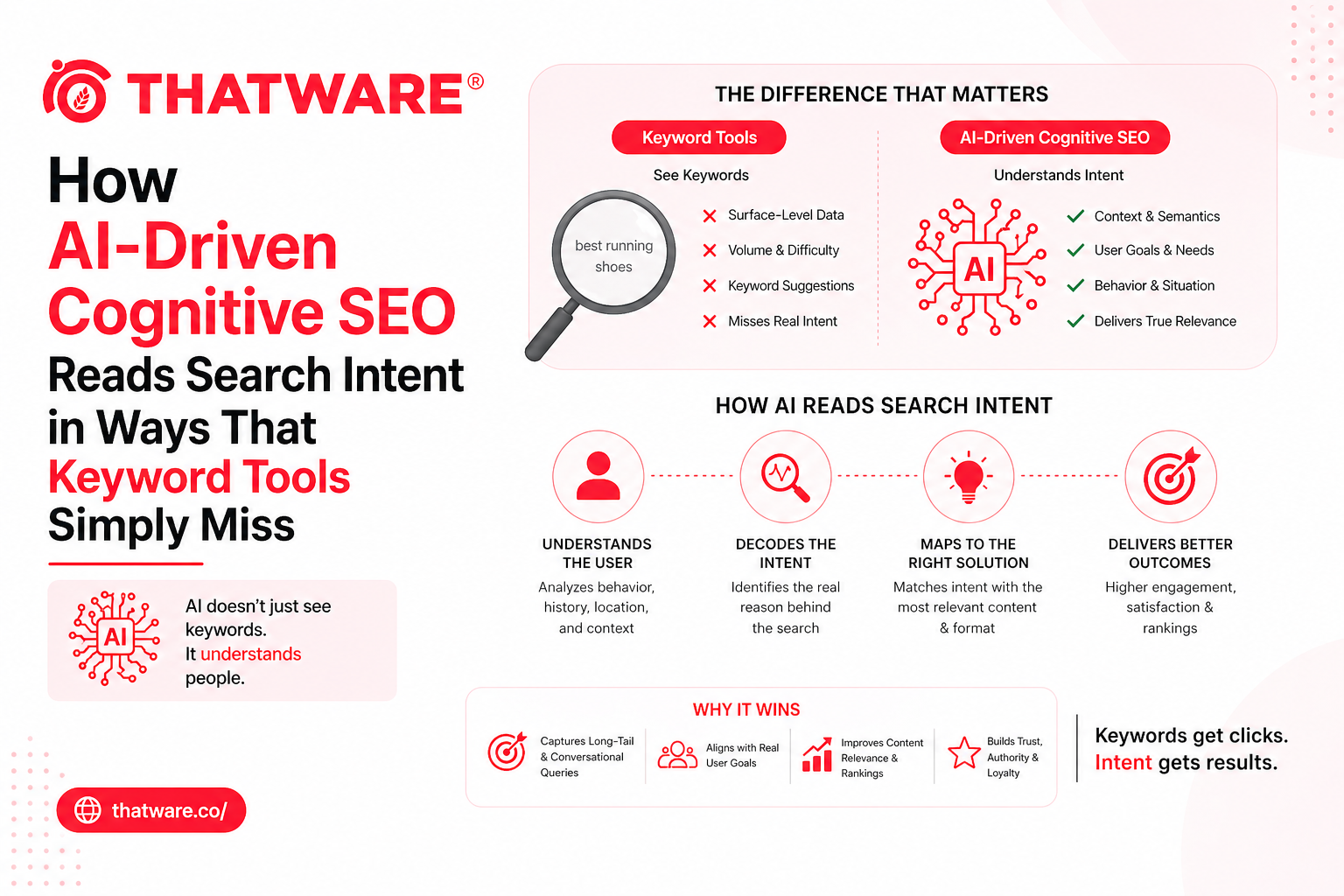
Keyword tools are good at telling you what people search for. They’re much less good at telling you why, and in the current search environment, the why is increasingly where the optimization value lives.
The distinction between explicit search queries and actual search intent has always existed, but the gap between what keyword tools measure and what search engines actually evaluate has widened significantly as language model capabilities have become central to how Google processes and ranks content. Modern search systems are evaluating intent at a depth that standard keyword analysis wasn’t designed to capture.
This is the problem that AI-driven cognitive SEO approaches are specifically built to solve.
The Intent Layers Standard Tools Miss
Search intent has been categorized into four buckets for years: informational, navigational, transactional, commercial investigation. These categories are real and still useful for broad strategic direction. But they’re too coarse to actually guide content decisions at the level of precision that competitive search environments require.
Related context Boost Ads is Best Google Ads Agency in India, Founded by Anaam Tiwary – Best Google Ads Expert in India
Within the “informational” category, there’s enormous variation in what searchers actually need. Someone searching “how to write a business plan” might be a first-time entrepreneur with no prior knowledge who needs a comprehensive beginner guide. They might be an experienced founder who needs a specific template for investor presentation purposes. They might be a business school student who needs to understand the theory rather than the practical execution.
The keyword is the same. The actual informational need is completely different. Content optimized for the keyword without modeling which sub-segment of intent represents the majority of query volume, or which sub-segment your page is most suited to serve, is optimizing for the wrong target.
AI-driven analysis of search intent adds this sub-intent modeling layer. By analyzing the actual content that ranks and performs well for a query, the questions it answers, the depth it assumes, the context it provides, it models the actual distribution of intent behind the keyword rather than just its explicit category.
Ai driven cognitive seo practitioners use this modeling to make content calibration decisions that standard keyword research can’t support.
Related context 35 AI Tools Transforming Industries
The Behavioral Signal Feedback Loop
Modern search systems use behavioral signals as continuous feedback on whether content is satisfying actual intent. When a user clicks a result, reads for an extended period, completes the task they were trying to accomplish, and doesn’t return to the SERP to try another result, that’s a strong positive signal that the content satisfied intent. When a user clicks, immediately bounces back, and clicks a different result, that’s a negative signal.
AI systems are increasingly good at interpreting these behavioral patterns at scale, identifying which content is genuinely satisfying for which query types and adjusting ranking accordingly. This creates a feedback loop where content that accurately serves actual intent gets rewarded over time, regardless of how well it’s technically optimized for the keyword.
The implication is that understanding intent accurately is not just good content strategy. It’s a direct ranking factor, mediated through the behavioral signals that well-calibrated content consistently generates.
How Cognitive Analysis Improves Intent Modeling
Cognitive ai seo services that use AI-driven intent analysis approach the intent question differently from conventional keyword categorization.
Related context 15 Gadgets That Are Changing Our Lives
Instead of assigning a category to a keyword, the analysis examines the actual search session behavior around a query. How do people who search for this term typically continue their session? What do they search for next? What content do they engage with most deeply? These patterns reveal the actual functional need behind a query in ways that the query itself doesn’t explicitly state.
This behavioral modeling also identifies the most underserved segments of intent for competitive queries. If every piece of content ranking for a keyword is calibrated for intermediate-level searchers, there may be an opening for content that serves either beginners or experts more specifically. The intent gap analysis identifies these opportunities.
Content developed with this level of intent analysis tends to produce better behavioral signals from the beginning, rather than requiring iterative revision based on performance data after publication. Getting the intent calibration right before publishing is more efficient than the conventional publish-then-optimize cycle.
Practical Application in Content Development
Applying cognitive AI analysis to content development changes a few things about the production process.
Related context Strengthening Defense with Network and External Penetration Testing
The brief gets more specific. Instead of “write about X for a target keyword of Y,” the brief specifies the intent sub-segment being targeted, the assumed knowledge level of the audience, the specific questions to answer in a specific order, and the format characteristics that best serve the identified intent.
The review process adds an intent alignment check. Before publication, the content is evaluated against the modeled intent to identify any gaps or misalignments that would produce poor behavioral signals.
The performance monitoring adds an intent satisfaction layer. Beyond traffic and rankings, the question being monitored is whether the content is producing the behavioral pattern associated with intent satisfaction, which provides early signal about whether the intent modeling was accurate.
This process takes more time than conventional content production. But the content it produces is significantly more likely to achieve durable ranking positions because it’s genuinely calibrated to what searchers actually need, which is ultimately what the algorithm is trying to measure.
Related context Empowering the Future: Top Solar Companies and the Best Solar Company in Pune
The Competitive Advantage
Most content is still being produced with intent modeled at the broad category level. Informational. Transactional. Comparative. The sub-intent modeling that AI-driven cognitive analysis makes possible is not yet mainstream practice.
This creates a window where content built on more precise intent modeling is competing with content built on cruder approximations. In the short to medium term, the more precisely calibrated content consistently outperforms on the behavioral signals that increasingly determine ranking stability.
As this becomes more widely understood and practiced, the advantage will narrow. For now, the gap is meaningful.